
Annual Report 2022-2023
On this page
Message from the Chairperson

As Chairperson of the Specific Claims Tribunal, it is my pleasure to present the annual report for the fiscal year 2022–2023.
This year the Tribunal was honoured to return to in-person and in-community hearings, after a number of years adapting to virtual and hybrid hearings due to the COVID-19 pandemic. A unique aspect of the Specific Claims Tribunal is that it goes where it is needed: the Tribunal prefers to meet First Nations claimants where they live—figuratively and literally—not only to deliver justice where wrongs have occurred, but to ease the burden on community witnesses who might otherwise need to travel long distances to tell their stories. Where requested and where appropriate, however, the Tribunal is pleased to offer virtual hearings.
The return to in-person and in-community hearings has offered the Tribunal a chance to reflect on the way it conducts its business, and the Tribunal is buoyed by the fact that it increasingly sees the settlement of claims that come before the Tribunal. With a mandate for reconciliation, the focus of the Tribunal’s work is restorative justice, and restorative justice is best achieved by agreement between the parties. The Tribunal recognizes that there are claims where the parties cannot agree on the main issue, but the Tribunal continues to seek common ground regarding facts, issues, and other aspects of claims via regular case management conferences, to reconcile parties as much as possible before coming to a final decision.
In an effort to encourage further agreement, I would like to take this opportunity to remind stakeholders that, in addition to adjudication, the Tribunal offers mediation services intended to reduce the adversarial nature of the claims before it. Although this has not been a well-used service in the past, the development of Tribunal jurisprudence over the past decade has allowed us to develop the tools to bring parties to consensus: the foundation of the house is built, and the Tribunal invites parties to take advantage of mediation to solve major and minor issues, or come to a complete resolution. Mediation can occur at any point in the life cycle of a claim, including after some or all the evidence has been adduced.
In last year’s annual report, I announced that the Tribunal had turned to the advisory committee of stakeholders—including representatives of the Assembly of First Nations and the Government of Canada—to revise the Tribunal’s Rules of Practice and Procedure and make the resolution of claims more efficient. With the announcement last November that the Assembly of First Nations and the federal government are working together to reform the specific claims process—including the possibility of an independent resolution centre to review claims on a consensus basis—stakeholders asked the Tribunal to pause the review of the rules to focus their attention on the proposed endeavour. The Tribunal supports reform of the specific claims process and paused its review, although it remains committed to making its processes as efficient as possible. That having been said, the Tribunal’s work continues: it is still receiving new claims, still hearing evidence, and still releasing decisions.
I want to thank my fellow members as well as Tribunal staff for all of their efforts in transitioning the Tribunal back into in-person and in-community hearings. Our team of dedicated professionals continues to remain flexible, knowledgeable, and determined to deliver justice across the country.
Justice Victoria Chiappetta
Chairperson, Specific Claims Tribunal
About the Tribunal
Overview
The Specific Claims Tribunal (Tribunal), established on October 16, 2008, is part of the federal government’s Justice at Last policy and the product of a historic joint initiative with the Assembly of First Nations aimed at accelerating the resolution of specific claims in order to provide justice for First Nations claimants and certainty for government, industry, and all Canadians.
The specific claims process commences when a First Nation claimant submits a claim to the Minister of Crown-Indigenous Relations, for a determination on whether the claim will be accepted for negotiation. The claim is reviewed by the Specific Claims Branch of the Ministry. A legal opinion is prepared by departmental legal counsel. A recommendation then goes to the Minister.
The Tribunal has jurisdiction over claims that are not accepted for negotiation within three years or, if accepted, have been in negotiation for three years without reaching a settlement. Proceedings before the Tribunal are neither an appeal nor a review of the Minister’s decision.
The flow chart below provides a general view of the specific claims process.

What is a specific claim?
Specific claims can include alleged breaches of the Crown’s legal obligations relating to treaties, reserve lands and resources, or First Nations’ trust funds. The Tribunal is empowered to compensate First Nations claimants for these breaches to a maximum of $150 million. More particularly, specific claims are compensable claims related to:
- a failure to fulfill a legal obligation of the Crown to provide lands or other assets under a treaty or another agreement between the First Nation and the Crown;
- a breach of a legal obligation of the Crown under any legislation “pertaining to Indians or lands reserved for Indians”;
- an illegal lease or disposition of reserve lands;
- a breach of a legal obligation arising from the provision or non-provision of reserve lands;
- the Crown’s administration of reserve lands, “Indian moneys” or other First Nations’ assets;
- a failure to provide adequate compensation for reserve lands taken or damaged by the Crown or any of its agencies under legal authority; or
- fraud by employees or agents of the Crown in connection with the acquisition, leasing or disposition of reserve lands.
The Tribunal’s work
The claims that come before the Tribunal are often complex on the facts and on application of the law. Many claims, even if relatively straightforward, go to a full hearing on the merits of validity and, if found valid, compensation. Preliminary applications pertaining to jurisdiction, the admissibility of evidence, and other matters often arise. The record frequently includes oral history, expert witness evidence, and voluminous documentary evidence, sometimes spanning well over a century.
The process before the Tribunal reflects stakeholders’ interests and needs, and the objective of reconciliation. Hearings in First Nations claimants’ communities are an essential part of the process. This is not the norm in court proceedings, where the stakeholders must attend at a courthouse to access the proceeding as participants or observers. Thus, it is not possible for the Tribunal to schedule back-to-back hearings with court-like efficiency.
Accommodating cultural diversity
The Specific Claims Tribunal Act provides, at section 13, that the Tribunal may “take into consideration cultural diversity in developing and applying its rules of practice and procedure”. A list of how the Tribunal has developed expertise in carrying out culturally sensitive adjudicative proceedings without compromising the integrity of the process is found below.
- Oral History Hearings
- These hearings, held in First Nations’ communities, are often scheduled as early as possible in the life cycle of a claim before the Tribunal, in recognition of the importance of preserving the testimony of Elders. They are an essential part of the process and are reconciliatory.
In some cases, a truth-telling ceremony given by a group of Elders prior to the giving of testimony can be accepted by the Tribunal in lieu of swearing-in or affirming the evidence. - Site Visits
- The presiding member will, when requested, travel to the First Nation’s territory along with the parties, Tribunal staff, and community members to view the land that is the subject of a claim.
- Ceremonies
- Opening and closing ceremonies are sometimes conducted by members of the First Nation’s community prior to, or after, proceedings before the Tribunal. The Tribunal welcomes requests to participate in such ceremonies. Examples of these ceremonies include long house ceremonies involving song and dance, drumming ceremonies, smudging, and pipe ceremonies.
- Prayers
- Welcome prayers are often offered at the outset of a hearing by a Chief, Elder, or other designate.
- Accommodating Language
- The Tribunal welcomes witnesses who wish to testify in their mother tongues, with the assistance of qualified interpreters. This is a regular aspect of hearings held by the Tribunal.
In addition to the above, the Tribunal encourages ongoing professional development for Tribunal members and staff on matters relating to cultural diversity.
2022–2023 in review
Our people
Tribunal Members
The Specific Claims Tribunal Act states that the Tribunal shall consist of no more than six full-time members; or any number of part-time members, or combination of full-time and part-time members, so long as the combined time devoted to their functions and duties does not exceed the combined time that would be devoted by six full-time members. The Governor in Council shall establish a roster of six to eighteen superior court judges to act as members of the Tribunal. The Chairperson and other members may be appointed from the roster by the Governor in Council. Each member shall be appointed for a term not exceeding five years and holds office so long as the member remains a superior court judge. Each member, on the expiry of the first term of office, is eligible to be reappointed for one further term.
The Tribunal began the fiscal year with five members, mostly part-time. However, in the fall of 2022 the Tribunal lost one of its members due to the expiry of that member’s second term, bringing the total of remaining members at the end of the fiscal year to four. The Tribunal members who held office during the fiscal year are as follows:
| Tribunal Member | Appointment Date | Term Expiry | Full-time or Part-time |
|---|---|---|---|
| Justice V. Chiappetta | December 11, 2020 | December 11, 2025 | Full-time (Chairperson) |
| Justice W. Grist | May 18, 2016 | September 5, 2022 | Part-time (Member) |
| Justice T. Ducharme | April 13, 2021 | April 13, 2026 | Part-time (Member) |
| Justice D. MacDonald | April 19, 2022 | April 19, 2027 | Part-time (Member) |
| Justice D. Roy | May 26, 2022 | May 26, 2027 | Part-time (Member) |
Tribunal Staff
The Tribunal receives operational support from the Administrative Tribunals Support Service of Canada (ATSSC). The ATSSC provides staff, office accommodation, hearing venues, IT services, and many other tools and services needed to support Tribunal operations.
The Tribunal is, for the most part, at the required staffing level for effective functioning in terms of administration. The Tribunal consists of 12 public servant positions. Of those, six positions are shared with other tribunals serviced by the ATSSC, and one is vacant.
Organization Chart as of March 31, 2023
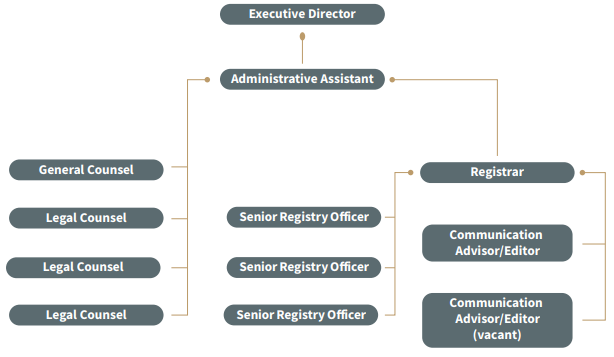
As with other tribunals serviced by the ATSSC, there is an assigned executive director responsible for the provision of services, supported by an administrative assistant. The registrar manages registry staff and communication advisors/editors, while legal counsel’s primary responsibility is direct support to Tribunal members even though they are employees of the ATSSC. The independence of Tribunal members is protected by law and legal tradition. Legal counsel in service to the Tribunal also function within legal norms of independence, which include the primacy of duty to the Tribunal.
Finances
In 2022–2023, the Tribunal had adequate financial resources to effectively manage its caseload. Financial resources come from an integrated budget managed by the ATSSC. More information on financial resources is available on the ATSSC website under the Reports section.
Caseload
Geographical Distribution
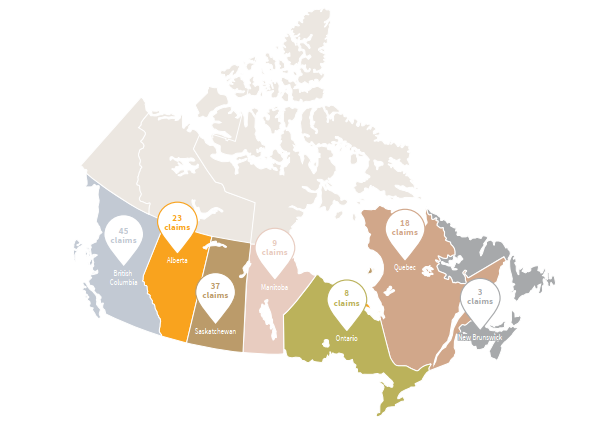
A total of eight new claims were filed with the Tribunal in the fiscal year 2022–2023, bringing the total of claims filed with the Tribunal since it opened its doors in 2011 to 143 claims. The geographic distribution of all claims is as follows:
Case Management
The Tribunal case manages all of its claims. On March 31, 2023, 56 claims had closed, leaving 87 claims before the Tribunal. During 2022–2023, the Tribunal held a total of 77 case management conferences, mostly held by teleconference.
Alternate outcomes
An objective of the Specific Claims Tribunal Act is to “create conditions that are appropriate for resolving valid claims through negotiations”. Although the Tribunal continued to offer Tribunal member-led mediation services when an interest in mediation is raised by a party or both parties, the preferred route to settlement of claims is negotiation.
As of March 31, 2023, approximately 44% of active claims before the Tribunal, i.e., 39 claims, were stayed further to the parties’ request to allow them to actively pursue alternative dispute resolution, mainly through negotiations.
The Tribunal saw 12 claims reaching final settlement in 2022–2023 and four claims having a consent order issued on a preliminary stage of the claim. This brings the total of claims settled between the parties to 36, and a total of 15 active claims having resolved the preliminary stage of the claim.
Overall, the Tribunal remains concerned about the time it is taking to conclude claims. On one hand, negotiation is the preferred means of resolving claims. On the other, the unduly lengthy process of negotiation militates against claims being resolved in a timely way and, if negotiations fail, may result in claims not being heard for many years after being filed with the Tribunal.
Jurisprudence
The Tribunal issued three decisions on validity and two decisions on applications in fiscal year 2022–2023. A summary of these decisions is found below.
In Kahkewistahaw First Nation v Her Majesty the Queen in Right of Canada, 2022 SCTC 5, the Tribunal determined that the Crown had breached both its pre- and post-surrender fiduciary duties with regard to the surrender of Indian Reserve No. 72A, located in Saskatchewan. The pre-surrender fiduciary breach related to the Crown allowing a nearby landowner to construct buildings on the reserve in trespass, while the post-surrender breaches included an unexplained delay of nearly 12 years between the surrender and the sale of the reserve, a failure to analyze whether subdivision of the reserve prior to its sale would be of greater economic benefit to the First Nation, and a post-surrender trespass by a rural municipality which built a road through the reserve in an unauthorized location. The Tribunal also determined that it did not have the jurisdiction to determine an asserted breach of the duty to consult and accommodate in an Aboriginal and treaty rights context.
In Metlakatla Indian Band v His Majesty the King in Right of Canada, 2022 SCTC 6, the Tribunal held that the Crown breached its fiduciary duty to the Metlakatla Indian Band by allowing the surrender and sale of nearly 14,000 acres of reserve land significantly undervalue, as well as the transfer of 313 acres of reserve land to a purchaser that was not surrendered by the First Nation. Whereas the land was purchased by the Grand Trunk Pacific Railway Company for $7.50 per acre, the Tribunal determined it was actually worth $31 per acre.
In Saulteaux First Nation v His Majesty the King in Right of Canada, 2023 SCTC 1, the Tribunal held that the First Nation claimant had not established the validity of its claim. The Saulteaux First Nation claimed that a surrender and exchange of 207 acres of reserve land on Jackfish Lake in Saskatchewan for 4,970 acres of land at Helene and Birch Lakes, as well as $20,000, was foolish and improvident, amounting to an exploitative bargain, and that the Crown should have withheld its consent to the surrender. In addition, the claimant argued the First Nation’s understanding of the bargain was inadequate. Relying on the evidence of two of three experts who testified, the Tribunal concluded the land at Helene and Birch Lakes, in addition to the cash payment, was more valuable than the reserve land surrendered at Jackfish Lake, and thereby not an exploitative bargain. Relying on oral history evidence, the Tribunal concluded that the First Nation’s understanding of the terms of the surrender and exchange was adequate.
In Cook’s Ferry Indian Band v His Majesty the King in Right of Canada, 2023 SCTC 2, the Tribunal rejected an application for leave to intervene, which arose as a result of a section 22 Notice pursuant to the Specific Claims Tribunal Act, SC 2008, c 22. Cicyetkwu Dunstan, who asserted that she represents the as-yet-unrecognized Aboriginal rights bearing collective, Pukaist Nation, applied for leave to intervene in a claim by the Cook’s Ferry Indian Band regarding two alleged illegal takings of reserve land. Cicyetkwu Dunstan asserts that the land at issue in the claim is part of the traditional territory of the Pukaist Nation, and has filed a claim in the British Columbia Supreme Court seeking a declaration that the Nation has Aboriginal title over the territory. Relying on the test for intervention in Rothmans, Benson & Hedges Inc v Canada (AG), [1990] 1 FC 74 (FCTD), the Tribunal determined that Cicyetkwu Dunstan did not have a direct interest in the claim before the Tribunal, nor did she show that a public law issue was raised, such that she should be granted leave to intervene on that basis.
In Waterhen Lake First Nation v His Majesty the King in Right of Canada, 2023 SCTC 3, the Tribunal allowed an application by the Crown to strike the claim. The claimant First Nation sought compensation for the loss of the ability to harvest in its traditional, but non-reserve, lands—a right protected by Treaty No. 6—following the building of the Primrose Lake Air Weapons Range in Northern Saskatchewan. As an administrative tribunal, the jurisdiction of the Specific Claims Tribunal is limited by its enabling statute, the Specific Claims Tribunal Act, SC 2008, c 22, which, at paragraph 15(1)(g), states that a First Nation may not file with the Tribunal a claim that is based on treaty rights related to activities of an ongoing and variable nature, such as harvesting rights. On this basis, the Tribunal determined it did not have the jurisdiction to hear the claim.
Looking ahead to 2023–2024
Continuing to encourage restorative justice
As previously mentioned, the Assembly of First Nations and the federal government are working jointly to reform the specific claims process. Although this collaboration may change the way the Tribunal conducts its business in the future, for now it is business as usual: the Tribunal continues to receive new claims, hear evidence at hearings across the country, and release decisions.
While the Tribunal has noticed and is encouraged that an increasing number of claims before the Tribunal lead to settlement, the Tribunal remains an important backstop to the specific claims process, available to eligible First Nations for determination of their claims.
Moving offices and upgrading the case management system
As with many organizations affected by the COVID-19 pandemic, it has become clear to the Tribunal that its organizational needs have changed with regard to office space: legal counsel and Tribunal members live and work outside of the National Capital Region and most of the remaining staff have shifted to a hybrid work model, splitting their time between the office and a telework location. Given that Tribunal staff and members do not require space within the Tribunal’s office on a regular basis, the Tribunal will move its current office location at 427 Laurier Avenue to a smaller office space located nearby at 344 Slater Street. This move will occur in the spring of 2024 and aims at reducing cost and decreasing the Tribunal’s office footprint for a more efficient and better use of space.
The Tribunal also anticipates upgrading its case management system in the new year. It’s expected that this upgrade will help the Tribunal keep track of pleadings, evidence, filings, and other claim material more efficiently going forward.